A brand has a flavour. And that may matter more than the logo.
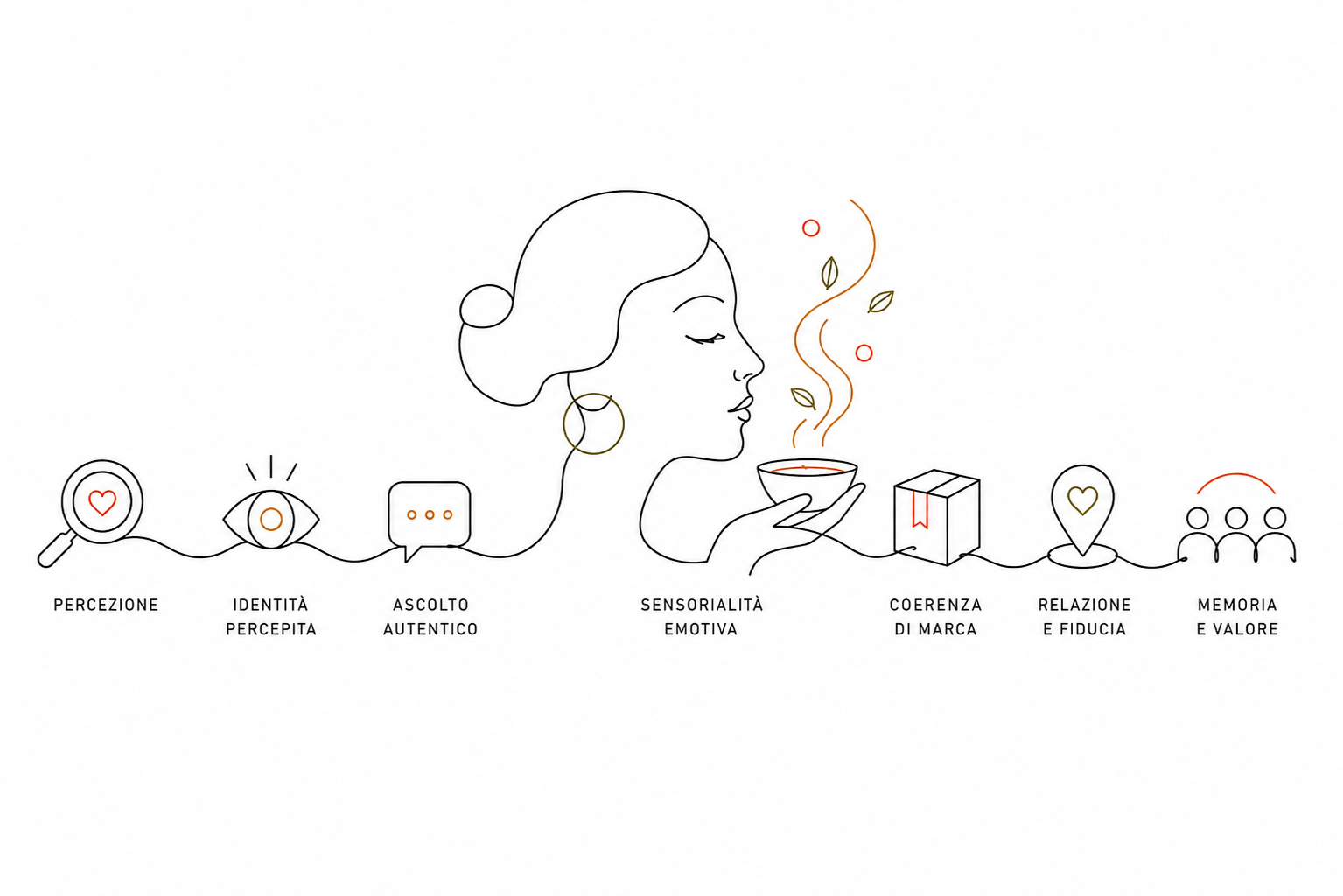
There are companies we remember perfectly, even years later.
And not always because of the product.
Sometimes we remember a conversation.
A meeting.
The way we were welcomed.
A feeling that is hard to describe.
A meeting.
The way we were welcomed.
A feeling that is hard to describe.
Other times the opposite happens.
We encounter brands that are flawless aesthetically, carefully built, with formally correct communication, and yet incapable of leaving any real trace in memory.
It is a subtle difference, but a decisive one.
Because people rarely build relationships with companies through logic. They do it through perception.
Think about what happens when we walk into a restaurant for the first time.
Before we even read the menu, we have already formed an opinion.
We notice the light.
The noise of the room.
The materials.
The way we are welcomed.
The distance between the tables.
The scent of the place.
The noise of the room.
The materials.
The way we are welcomed.
The distance between the tables.
The scent of the place.
None of these elements says anything about the food.
And yet all of them help to define the experience.
With brands, something surprisingly similar happens.
Long before we understand who they are, we begin to perceive them.
Through their language.
Their images.
The speed with which they respond.
The quality of their relationships.
The details they choose to look after.
Even through what they decide not to communicate.
Their images.
The speed with which they respond.
The quality of their relationships.
The details they choose to look after.
Even through what they decide not to communicate.
In other words, we taste them.
Not in the gastronomic sense of the term.
We taste them emotionally.
And this is where a question arises that may sound unusual, but that often proves extraordinarily effective:
what does your brand taste like?
Most organisations are used to describing themselves with words like innovation, quality, excellence, expertise or reliability.
Important words.
But also words that almost everyone now uses.
Far more interesting is watching what happens when we ask clients, colleagues, suppliers and employees to describe the company using the language of flavours.
Sweet.
Salty.
Sour.
Bitter.
Umami.
Salty.
Sour.
Bitter.
Umami.
Suddenly the conversation changes.
People stop repeating what the company says about itself and start talking about what they actually perceive.
And it is in that moment that something valuable emerges.
Not the declared identity.
But the lived identity.
FAQ – Design del Gusto and sensory identity
What is Design del Gusto?
Design del Gusto is an approach that uses the metaphor of flavours to explore the perceived identity of an organisation, a product or a brand.
Why associate a company with the five fundamental flavours?
Because sensory language allows people to express authentic perceptions that are hard to influence with rational frameworks or corporate conventions.
Which five flavours does the method use?
Sweet, salty, sour, bitter and umami. Each one evokes different emotional and relational characteristics.
How can a sensory profile help marketing?
It can guide tone of voice, communication, events, company culture and brand positioning in a way that is consistent with how people actually perceive the business.
Is Design del Gusto only useful in the food sector?
No. It can be applied to any organisation, product or service, because it works on perception and relationships, not on food.
Why is taste linked to memory?
Sensory experiences are remembered more easily than purely rational information. That is why the language of taste can become a powerful tool for building brand identity.