Branding has a flavour. Even when you don’t notice it.
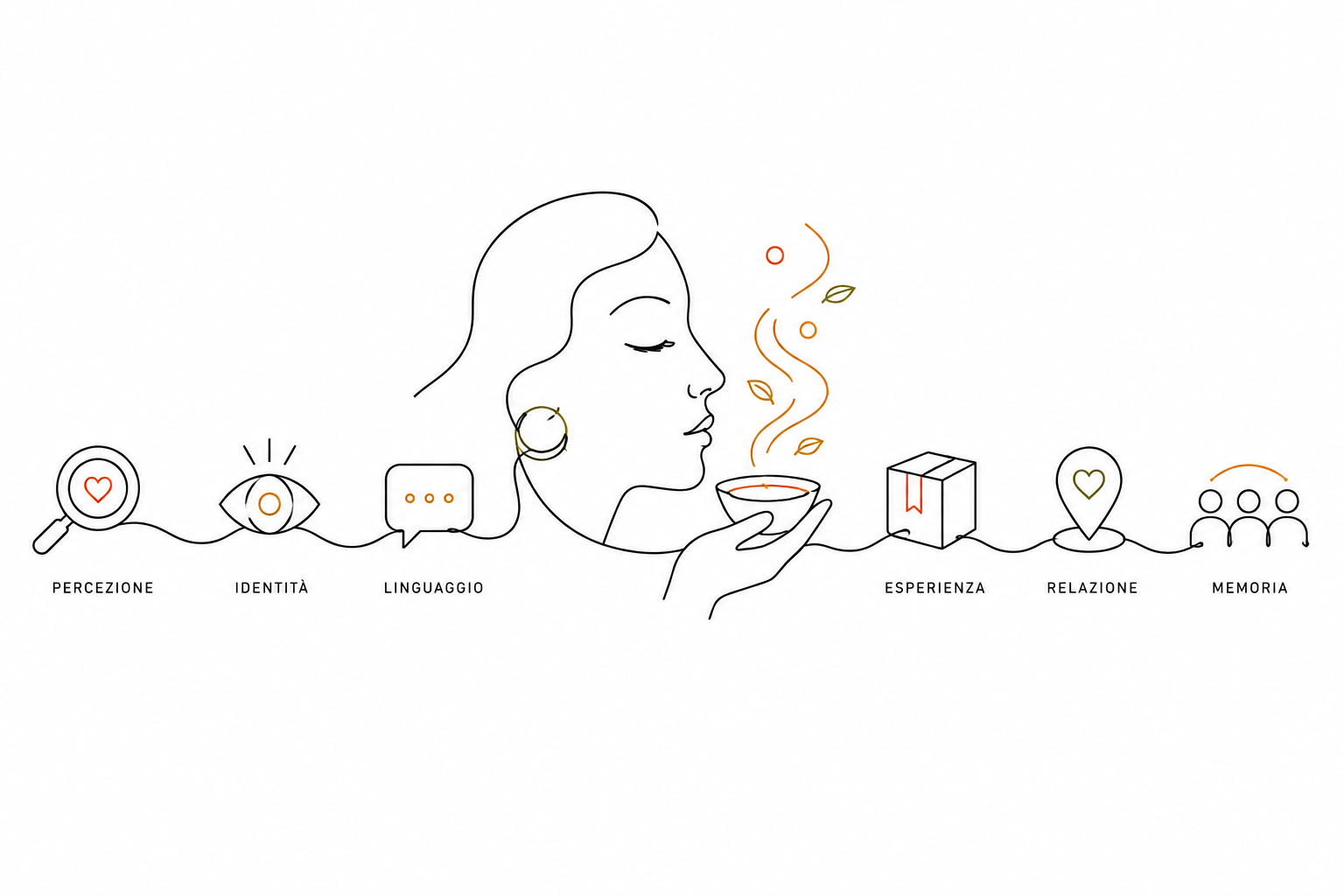
Design, perception and the new relational language of brands
There are brands that “taste” of technology.
Others that immediately convey craftsmanship.
Some evoke luxury before showing a product.
Others feel cold, impersonal or forgettable within seconds.
Others that immediately convey craftsmanship.
Some evoke luxury before showing a product.
Others feel cold, impersonal or forgettable within seconds.
The interesting part is that all of this happens long before any rational choice.
It happens in perception.
For years, branding was described mainly as aesthetic construction: logo, colour palette, packaging, visual identity. Today, though, something is changing. More and more often brands are perceived as complete sensory experiences, capable of generating atmospheres, expectations and relationships even before any purchase.
And this is where the concept of “taste” suddenly becomes central even outside the world of food.
Because taste is not only about what we eat.
It is about the way we interpret the world.
A website can feel elegant or aggressive.
An environment can convey calm or tension.
Packaging can seem authentic or artificial.
Even a digital interface today has its own perceptual texture.
An environment can convey calm or tension.
Packaging can seem authentic or artificial.
Even a digital interface today has its own perceptual texture.
In practice, the brain continuously builds emotional relationships with what it observes.
And it is interesting, because this phenomenon closely resembles relational marketing, even though it is often described only in terms of customer journey, CRM or loyalty.
In reality, the relationship begins much earlier.
It begins at the moment a brand generates a coherent sensation.
When everything seems to belong to the same invisible language:
the colours,
the materials,
the tone of voice,
the photography,
the content,
the spaces,
the speed of interactions,
even the visual rhythm of a page.
the colours,
the materials,
the tone of voice,
the photography,
the content,
the spaces,
the speed of interactions,
even the visual rhythm of a page.
This is where branding stops being decoration and becomes experience.
Think of the world of restaurants.
Before we taste a dish we observe the room, the light, the menu, the materials, the language used online, the photographs, the reviews, the general atmosphere. In some way the “flavour” begins long before the actual taste.
The same happens in digital today.
A contemporary brand is experienced as a perceptual ecosystem. And the more coherent that ecosystem appears, the more the feeling of authenticity grows.
That is why communication today can no longer limit itself to “explaining” a product.
It has to build a sensory relationship with people.
A relationship made of continuity, recognisability and memory.
And this is probably why some brands feel immediately familiar while others, even investing enormously in advertising, continue to look anonymous.
It is not only a question of visibility.
It is a question of mental presence.
In the contemporary world people do not remember everything they see. They remember what leaves a coherent emotional trace over time.
And this is where taste takes on a much deeper meaning.
Taste becomes relationship.
It becomes the way a brand comes across as stable, recognisable and human in a digital ecosystem increasingly saturated with artificial signals.
Perhaps this is precisely the great transformation of contemporary communication.
We are no longer designing only visual identities.
We are designing perceptual experiences capable of creating relationships even before the choice.
FAQ — Branding, taste and relational marketing
What does it mean that a brand has a “flavour”?
It means that every brand generates an emotional and sensory perception made of colours, tone of voice, materials, images and overall experience.
How is branding connected to relational marketing?
Contemporary branding builds relationships through perceptual coherence, recognisability and emotional continuity over time.
Why does experience matter more than advertising today?
Because people increasingly choose on the basis of sensations and the quality of the relationship they perceive with a brand.
What is a perceptual ecosystem?
It is the sum of all the elements that contribute to a brand’s perception: website, content, design, packaging, social media, environments and language.
Why do some brands feel memorable and others not?
Because memorable brands create sensory and relational continuity, leaving a coherent mental trace over time.
What is design’s role in contemporary communication?
Today design does not only serve to make something beautiful, but to build meaning, atmosphere and relationship with people.