The future of brands will no longer be visual. It will be relational.
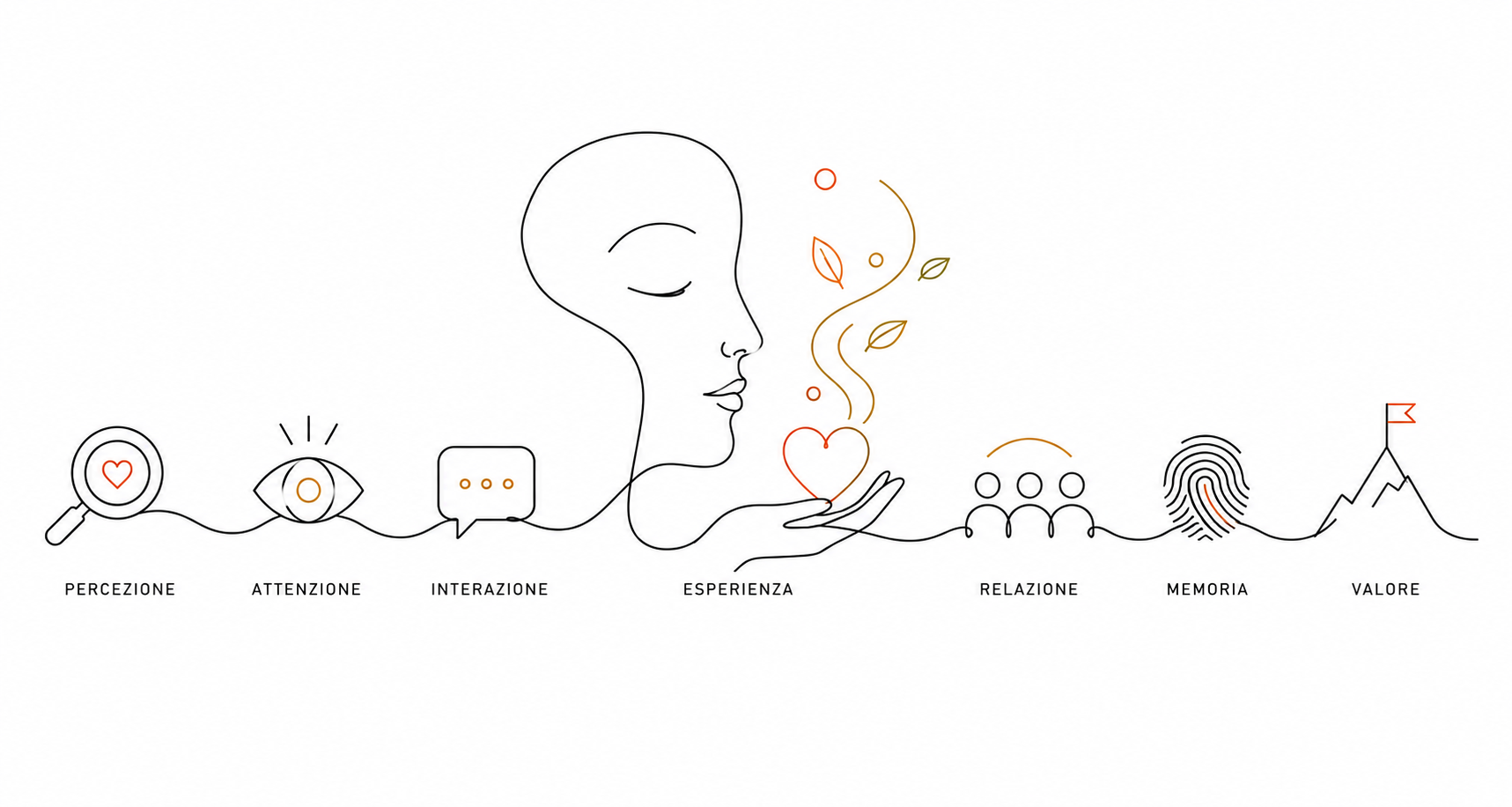
Design, perception and the shift from identity to experience
For a long time, brands worked mainly on their image.
Being recognisable meant having a good logo, a coherent palette, memorable advertising or well-designed packaging. In some way, “looking good” was enough to build value.
Today, however, something is changing profoundly.
People no longer experience communication as an orderly sequence of messages. They live immersed in a continuous flow of stimuli, images, content, interfaces, notifications, physical and digital environments that constantly overlap.
In this scenario, brands are no longer perceived as simple visual identities.
They are perceived as experiences.
And it is interesting, because this transformation affects practically every sector: food, hospitality, retail, fashion, luxury, technology, wellness, even the financial world.
Think about how quickly we now form unconscious impressions.
We walk into a place and within seconds we sense whether we feel at ease. We open a website and immediately understand whether it conveys order or confusion. We look at packaging and, before reading the product name, we have already begun to build expectations.
That is how the brain works.
It does not only interpret information. It interprets relationships.
And this is where design, branding and relational marketing begin to converge.
Because a relationship does not begin only with customer service or a loyalty programme. It begins much earlier. It begins in the way a brand builds perceptual continuity over time.
Tone of voice.
Images.
Light.
Materials.
The rhythm of interactions.
The speed of an interface.
The quality of the content.
The ability to generate atmosphere.
Images.
Light.
Materials.
The rhythm of interactions.
The speed of an interface.
The quality of the content.
The ability to generate atmosphere.
All of it contributes to building a form of mental presence.
And this is probably why some brands feel immediately authentic while others, even investing enormous budgets in advertising, continue to come across as cold or artificial.
The point is not only what they communicate.
It is how they make people feel.
For years, marketing worked mainly on persuasion. Today, the strongest brands seem to be building something very different: coherent relational ecosystems.
They do not constantly interrupt attention. They manage instead to create familiarity.
And that familiarity does not come from the obsessive repetition of advertising messages. It comes from coherence.
When everything seems to belong to the same invisible language.
This is where design stops being decoration and becomes perceptual culture again.
That is why the concept of taste becomes so interesting today, even outside food.
Because taste is not only about what we consume. It is about what we recognise as coherent with our way of perceiving the world.
A brand can have taste.
An interface can have taste.
An environment can have taste.
Even a digital communication system can feel elegant, harmonious, aggressive, cold or human.
An interface can have taste.
An environment can have taste.
Even a digital communication system can feel elegant, harmonious, aggressive, cold or human.
In the contemporary world, people do not remember everything they see.
They remember what generates a sensation that lasts over time.
And perhaps this is the real transformation of contemporary communication.
We are no longer designing only visual identities.
We are designing perceptual systems capable of building relationships, memory and meaning.
FAQ — Brand experience, design and relational marketing
What does a brand’s relational experience mean?
It means the way a brand builds relationships through perception, continuity, atmosphere and the quality of the overall experience.
Why are brands perceived as experiences today?
Because people interact with complex digital and physical ecosystems, where design, content and interfaces continuously influence emotional perception.
What is design’s role in relational marketing?
Design helps to create perceptual continuity and recognisability, making the brand more memorable and coherent over time.
Why is coherence so important in communication?
Because coherence generates familiarity and trust — two essential elements in building contemporary relationships.
How does content influence the perception of a brand?
Content helps to create atmosphere, authority and narrative identity, influencing the way people interpret the brand.
What does designing a perceptual ecosystem mean?
It means building an integrated system made of design, language, content, user experience and emotional relationship.